Many companies in Thailand are fear of missing out on GenAI. Unfortunately, integrating GenAI into a business model is not easy, especially when most companies in Thailand ask the Technical team to handle the integration. Many of my students who work in tech companies need help achieving this, so I wrote this article hoping to help them get there.
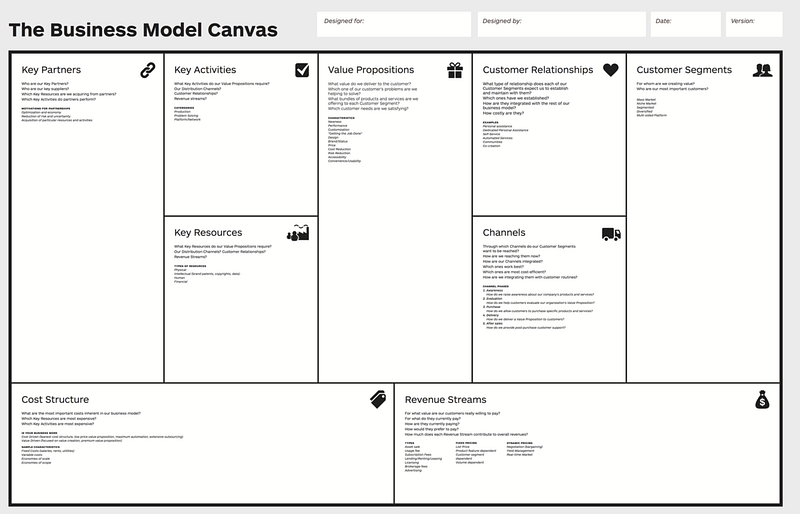
he Business Model Canvas (BMC) is a strategic management template used for developing new business models or documenting existing ones. It offers a visual chart with elements describing a firm’s value proposition, infrastructure, customers, and finances. In this article, I adapt the BMC to create a framework for a General AI business.
Value Propositions:
This could include solving complex problems, automating decision-making processes, enhancing personalization in services, or providing scalable insights that humans can’t easily replicate.
Example: Using Generative AI to Enhance Value Proposition in Retail
We can implement a generative AI model to provide personalized product recommendations based on customer behavior and preferences. This can increase customer satisfaction and drive sales.
We can also use AI to predict demand for products, optimize inventory levels, and reduce stockouts or overstock situations. This ensures that popular items are always available while minimizing inventory costs.
We can deploy AI-powered chatbots to provide instant and personalized customer support. This is probably what most companies will be doing, so it might not be much of a value if everyone have it. These chatbots can handle a variety of tasks, from answering common queries to assisting with purchases.
We can utilize generative AI to create personalized marketing content, such as emails, social media posts, and advertisements, tailored to individual customer segments. This can improve engagement and conversion rates.
We can use Generative Adversarial Network (GAN) to learn the underlying distribution of the customer data. This helps in understanding complex patterns and relationships in the data.
We can train the generative model on the customer data. This involves feeding the data into the model and allowing it to learn the distribution and latent representations of different customer segments. After training, use the latent representations generated by the model to perform clustering. I taught this laten representation in SNA a while back, do know if any of you remember the technique. Also, techniques such as K-means or hierarchical clustering can be applied to the latent space to identify distinct customer segments.
Analyze the resulting clusters to interpret and label the customer segments. For example:
- Segment 1: Bargain Hunters — Customers who frequently purchase low-cost items.
- Segment 2: High Spenders — Customers who make infrequent but high-value purchases.
- Segment 3: Casual Shoppers — Customers who browse frequently but purchase occasionally.
- Segment 4: Loyal Customers — Customers with high purchase frequency and high engagement.
Channels:
Determine how your General AI will reach its customers. This could involve direct sales, partnerships with existing tech firms, online platforms, or through API integrations.
Example: Using Generative AI for Customer Outreach Optimization
We can try to use generative AI to create detailed profiles of each customer based on their behavior and preferences. Makesure that you have business unit heavily invole in looking over the profile. Techniques such as deep learning can help in understanding complex patterns in customer data.
Use a generative AI model (such as GPT-4) to create personalized content for each customer. This could include:
- Personalized email campaigns
- Custom social media posts
- Tailored SMS messages
- Dynamic website content
Predict the most effective channel for reaching each customer based on their past interactions and preferences. Machine learning models can be used to analyze historical data and determine the likelihood of engagement on each channel.
Customer Relationships:
Establish how you will interact with your customers. For a General AI, this might include ongoing support and training, updates based on AI learning advancements, and community-driven development.
Example: Using Generative AI for Enhanced Customer Support
We can start by collect data from various customer interactions, including support tickets, chat logs, email exchanges, and feedback forms. This data will help in understanding customer issues, preferences, and behavior patterns.
We can use AI to perform sentiment analysis on the collected data to understand customer emotions and satisfaction levels. This helps in identifying customers who may be unhappy or require special attention. Use a generative AI model like GPT-4 to create personalized responses to customer queries. The model can be fine-tuned on the company’s support data to ensure the responses are accurate and align with the company’s tone and policies.
We can also use AI to automate follow-ups with customers after support interactions. Personalized follow-up messages can be generated to check if the issue was resolved satisfactorily and to offer further assistance if needed. Generate and send personalized feedback requests to customers after their issues have been resolved. Use AI to analyze the feedback and identify areas for improvement in the support process.
Revenue Streams:
Explore potential ways to generate revenue. This could be through subscriptions, pay-per-use models, licensing fees, or even offering bespoke solutions tailored to large enterprise clients.
Example: Using Generative AI for Personalized Product Recommendations and Dynamic Pricing
Use machine learning techniques to segment customers based on their behavior and preferences. This segmentation can be used to tailor recommendations and pricing strategies. We can implement a generative AI model, such as a Recurrent Neural Network (RNN) or Transformer-based model, to generate personalized product recommendations for each customer. This model can learn patterns in the data to suggest products that a customer is likely to purchase.
We can also use AI to implement a dynamic pricing strategy. This involves analyzing market conditions, competitor prices, and customer willingness to pay. A model such as a Reinforcement Learning (RL) agent can be used to optimize prices in real-time to maximize revenue. Use generative AI to create personalized marketing content, such as email campaigns, social media posts, and advertisements. This content should be tailored to each customer segment to increase engagement and conversion rates.
Continuously monitor the performance of the recommendations, pricing strategies, and marketing campaigns. Use AI to analyze the results and make adjustments to improve effectiveness.
Key Resources:
List the assets essential for your AI venture, like talented AI researchers, robust computing infrastructure, access to large and diverse data sets, and intellectual property rights.
Example: Using Generative AI to Optimize Software Development Resources
Use generative AI to analyze the productivity of developers. This can involve:
- Analyzing commit history to understand coding patterns and productivity
- Evaluating the time taken to resolve issues and complete tasks
- Identifying the most efficient developers and the techniques they use
We can implement a generative AI model to optimize task allocation based on developer strengths and project requirements. The model can predict which developer is best suited for a particular task, improving overall efficiency. Use AI to predict potential bugs and maintenance needs based on historical data. This can help in proactively addressing issues before they escalate, saving time and resources. Implement AI tools to assist with code generation and review. Tools like GPT-4 can help in generating boilerplate code, writing documentation, and reviewing code for potential issues.
Key Activities:
These could include continuous AI training, development of AI models, data processing and analysis, and maintaining IT infrastructure.
Example: Using Generative AI to Optimize Marketing Campaigns
We can use generative AI to segment the audience based on their behavior and preferences. This helps in creating targeted marketing campaigns for different segments. Implement a generative AI model like GPT-4 to create personalized and engaging content for different marketing channels, including:
- Social media posts
- Blog articles
- Email newsletters
- Advertisements
You can use AI to analyze historical campaign data and optimize future campaigns. This includes:
- Predicting the best times to post on social media
- Determining the most effective email subject lines
- Analyzing customer responses to different types of content
Do not forget to continuously monitor the performance of marketing campaigns using AI to analyze key metrics such as engagement rates, conversion rates, and ROI. Use this data to make real-time adjustments to the campaigns.
Key Partnerships:
We can begin by identify other companies or organizations you might team up with. Partnerships could be with academic institutions for research, technology providers for hardware and software, or data providers.
Example: Using Generative AI to Optimize Key Partnerships
We can use generative AI to facilitate clear and effective communication between the technology startup and the manufacturing company. This includes:
- Automating the generation of meeting summaries and action items.
- Translating technical jargon into easily understandable language for both parties.
Generative AI can assist in collaborative product development by:
- Generating design ideas and prototypes based on initial concepts.
- Providing real-time feedback on product designs by analyzing market trends and customer feedback.
We can also use generative AI to analyze market data and develop joint strategies that benefit both partners. This includes:
- Identifying market opportunities and potential risks.
- Generating reports on competitive analysis and market trends.
Generative AI can help draft and optimize partnership agreements by:
- Automatically generating contract drafts based on predefined templates.
- Analyzing previous agreements to suggest terms that have led to successful partnerships.
Cost Structure:
This includes research and development expenses, operational costs like server upkeep, software development, and personnel salaries.
Example: Using Generative AI to Optimize Cost Structure in Manufacturing
We start by collecting data from various sources within the manufacturing process, including:
- Machine performance and maintenance logs
- Production timelines and output rates
- Labor costs and workforce schedules
- Supply chain and inventory management data
- Energy consumption records
We can then use generative AI to predict when machines are likely to require maintenance. This can prevent costly breakdowns and reduce downtime. Analyze production processes to identify inefficiencies and optimize workflows. Generative AI can simulate different production scenarios to find the most cost-effective methods.
Implement AI to optimize inventory levels, reducing holding costs while ensuring that production is not interrupted due to a lack of materials. Use AI to create optimized workforce schedules, ensuring that labor costs are minimized while meeting production targets. Finally, Analyze energy consumption patterns and suggest ways to reduce energy costs, such as optimizing the operation times of high-energy-consuming machines.
Each of these components is critical in plotting the business strategy using GenAI in company, ensuring that all necessary aspects are considered to facilitate planning and execution. This structured approach allows for a thorough examination of the business’s foundations and growth opportunities.
By applying these examples to the BMC, I hope that you can develop a comprehensive business strategy for using Gen AI in your company, ensuring that all aspects from value delivery to cost management are carefully planned. This approach helps in aligning business operations with market needs and potential revenue opportunities.
 Alex.Worapol.Pongpech
Leave a comment