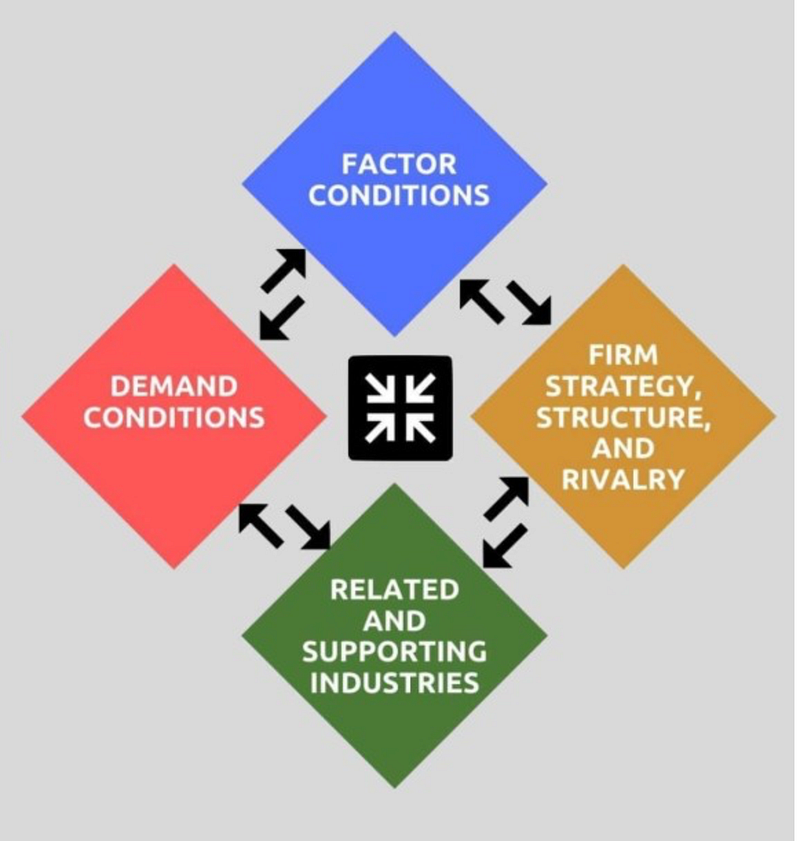
Porter’s Diamond Model is a framework for analyzing national competitive advantage. It can be adapted to create a comprehensive AI strategy for a company, considering both internal and external factors to drive innovation and gain a competitive edge. In this article, I use Porter’s Dimond Model to create an AI strategy that started from the business paradigm instead of the usual technical paradigm.
This strategic framework leverages Porter’s Diamond Model to ensure that the company not only competes but leads in its industry through the strategic use of AI. By considering both internal capabilities and external market conditions, the company can plan and execute an AI strategy that promotes sustainable growth and innovation.
1. Factor Conditions
AI Strategy:
- Invest in AI Infrastructure: Upgrade computing resources to handle large-scale data processing and machine learning tasks. This investment can be very costly and must be investigated with proper due diligence. One of the most cardinal sins in data-driven migration that I experienced was the premature investment in data infrastructure.
- Develop Technical Expertise: Train existing staff and hire new talent specializing in AI, data analytics, machine learning, and technologies. However, companies should do a proper data insights support before plunging headfirst into reskilling staff.
2. Demand Conditions
AI Strategy:
- Identify Customer Needs: Use data analytics to understand the needs and gaps in the current services. Please do not put the company’s data on the LLM provider to ask for insight. Do due diligence and talk with business units.
- Customize AI Solutions: Develop AI-driven tools and personalized plans based on data analysis. Ask the data team to help regarding planning for a longterm customer retaintion.
3. Related and Supporting Industries
AI Strategy:
- Collaborate with Academia and Industry: Form partnerships with universities for cutting-edge research and with tech companies for AI tool integration. This practice is definitely a win-win situation for both industry and academia. However, both sides must clearly understand each other’s constraints.
- Leverage Suppliers: Engage with data providers and AI technology firms to enhance your AI capabilities. DO NOT DO IT ALL YOURSELF, and DO NOT REINVENT THE WHEEL. Win fast and quick if you can.
4. Firm Strategy, Structure, and Rivalry
AI Strategy:
- Incorporate AI into Business Strategy: Make AI a core part of the company’s strategic initiatives. Sadly, this practice is not common. I found that most companies are doing “ Using AI to find Business Strategy.”
- Promote a Culture of Innovation: Encourage experimentation and the adoption of AI technologies across all departments. However, be sure that they have a clear vision of why they are innovating.
- Monitor Competitors: Monitor competitors’ use of AI to ensure the company maintains a competitive edge. Yes, you must know your “enemy,” as in Sun Tzu’s The Art of War.
5. Government
AI Strategy:
- Navigate Regulatory Compliance: Ensure all AI tools comply with PDPA regulations and data protection laws. Yes, leaks do happen.
- Engage with Policymakers: Actively participate in discussions on AI policy to shape regulations that affect the sector, specially in the Fintech.
6. Chance
AI Strategy:
- Flexibility to Adapt to Breakthroughs: Stress the importance of maintaining agile development practices that can quickly integrate new AI technologies and breakthroughs, empowering AI developers and instilling confidence in their ability to adapt.
- – Risk Management: Develop contingency plans for rapid shifts in AI technology and market conditions. Yes, it happens, and often, so having a contingency plan is a must.
 Alex.Worapol.Pongpech
Leave a comment