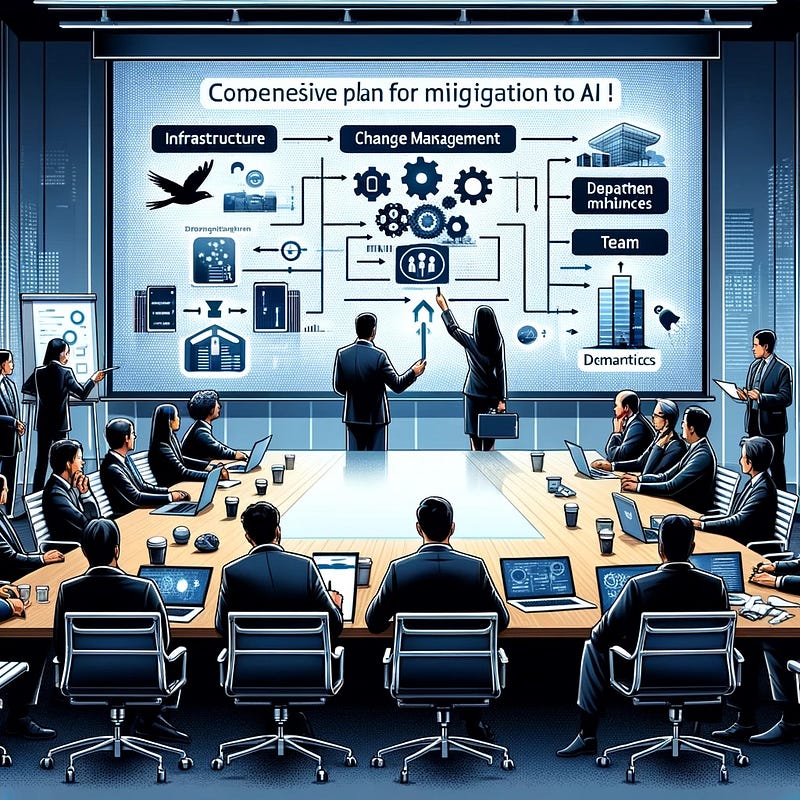
The Chief Technology Officer (CTO) should play a pivotal role in overseeing and guiding the transition effectively when companies are migrating to AI. Unfortunately, from my experience, either CTOs were not technically skilled enough or did not get the full support from the CEO. I have a few key considerations and areas of focus when working as or for a CTO during this migration process.
The Ten Strategics Considerations for CTO
- Strategic Alignment: This is the most fundamental and most crucial area that must be fully aligned. Ensure that AI initiatives align with the company’s overall strategic objectives. This means understanding how AI can enhance or transform business models, improve customer experiences, and create competitive advantages. Companies that are just saying AI will help us or we will use AI to provide better services for our customers are just purely speculated or a PR campaign.
- Technology Infrastructure: You can align your AI strategically all day, but you need to consider your technology infrastructure systematically, your AI migration will fail. Evaluate the current technology infrastructure to determine if it can support AI applications. Please do not just seek the money to upgrade your technology stack. You might actually not need the upgrade in the initial stage. Remember that the money you spend on the stack will have to be recouped later. This may involve upgrading hardware, adopting cloud services, or investing in scalable and secure data storage solutions.
- Data Governance and Quality: Not enough companies pay enough attention to DG and DQ. Garbage in is garbage out is full-blown in AI migration. Establish strong data governance frameworks to ensure data quality, integrity, and security. AI models depend on high-quality data, so the CTO must ensure that data management practices are in place to clean, label, and securely store data.
- Talent and Skills: Do not be the HERO, the know-it-all CTO. It is not your job to know everything, but it is your job to get it done effectively and efficiently. Assess the current team’s AI capabilities and identify gaps in skills and expertise. This may require hiring new talent with AI experts or providing training and development opportunities for existing staff.
- Ethical and Legal Considerations: Please pay attention to the ethical implications of AI, including bias in AI models and the impact of AI on employment. Otherwise, it will come back and bite your ass in a big way. Ensure compliance with all relevant regulations and ethical standards related to AI, data privacy, and security.
- Partner and Vendor Management: This is one of the most difficult considerations that you must carefully plan as a CTO. In Asia, the vendors are typically chosen either by connection or by vendor size. Evaluate and select technology partners and vendors who can provide AI solutions, platforms, and tools. Establish strong relationships and ensure that these partnerships support the company’s AI objectives.
- Change Management: As a CTO, you need a lot of support from your HR on change management. Get their help but keep the HR from the show. Implement effective change management strategies to facilitate the adoption of AI across the organization. This includes communicating the benefits and implications of AI to all stakeholders, managing cultural shifts, and ensuring that teams are prepared for changes in workflows and processes.
- Monitoring and Evaluation: Delegating, delegating, and delegating is one key strategy for doing this well. Get your director involved ASAP. Establish metrics and KPIs to monitor the performance of AI initiatives and assess their impact on business outcomes. Continuous evaluation will help adjust strategies and address any challenges that arise.
- Scalability and Maintenance: I would ask my team to work on a three-year plan first. Plan for the scalability of AI systems to accommodate growth and changing business needs. Also, carefully consider the maintenance and ongoing training of AI models to ensure they remain accurate and effective over time.
- Innovation and Experimentation: As a CTO, I would monitor new external innovations and experiments and focus on how to utilize them for our AI migration. I would also encourage a culture of innovation and experimentation, allowing pilot projects and proofs of concept to explore AI’s potential in different business areas without increasing too much technical debt.
For a CTO, managing the migration to AI is not just about the technical implementation; it’s also about leading the organization through a transformation that can redefine business processes, offerings, and competitive dynamics. Yes, you should and need to be technically competent to be a CTO in the AI era. Unfortunately, I have personally seen too many CTOs that are not.
 Alex.Worapol.Pongpech
Leave a comment