
The wasted resources on chasing rabbits, which is the exploration of data analytics, are no longer acceptable practices for promoting sustainability. Companies are focusing more on helping reduce carbon released through better innovation. For example, NVIDIA is working on a water-cooling GPU. Google Cloud and AWS are focusing on net zero.
While the data-driven organization era was exciting and brought us many innovations in data technology, it might have helped drive up carbon released into the atmosphere. It would be hard to argue with all the published successes of data-driven industries: Media and Entertainment, Netflix and Spotify, E-commerce: Amazon and eBay, Banking Industry: Bank of America and HSBC. The list goes on and on.
This success inspires so many other companies and industries to follow suit. Unfortunately, there is this concept which is called the diminishing returns. The more energy poured into finding needles in the stack might not reciprocate into gold pots at the end of the rainbow.
Unfortunately, asking companies not to spend resources on data analytics is not sensible. Helping and teaching companies to spend wisely and smartly on these resources might be more productive in promoting sustainability.
Compute Green AI
An article from HBR https://hbr.org/2023/07/how-to-make-generative-ai-greener addresses the energy consumption problem of Generative AI and ML. The three key carbon footprints that chief analytics or chief technology must be taken into consideration are :
- The carbon footprint from training the model
- The carbon footprint from running inference (inferring or predicting outcomes using new input data, such as a prompt) with the ML model once it has been deployed and
- The carbon footprint to produce data products.
In this article, I explore these considerations from a CTO’s perspective and how they can be implemented in organizations. I rely on my experience as a CTO and an educator in Thailand on key strategies that could help implement Green AI. As a CTO, one of my tasks is to use AI to facilitate business strategy. To do this, I utilized the 5E of implementing AI into the organization: Education, Exploration, Experiment, Exploit, and Expanse.
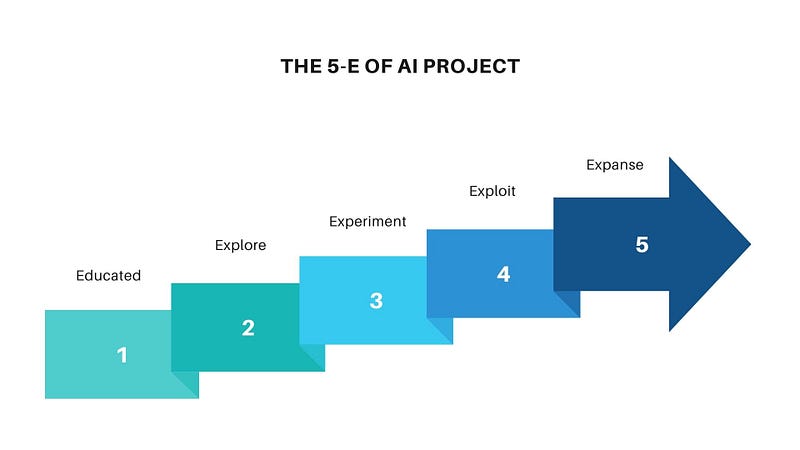
First, I developed a comprehensive plan to educate our stakeholders, focusing on our managers. Second, I aimed for my data teams to consistently explore, analyze, and derive insights that can unlock additional value for our business. Third, I encouraged each team to experiment with proof of concept (POC), potentially leading to minimum viable products (MVP). Last, I envisioned seamlessly integrating these POCs and MVPs into our company’s product offerings.

In the business landscape, it’s crucial to strike a balance between aggressive pursuit and strategic conservation. Is there a universal framework that most businesses can adopt for immediate implementation? While the responsibilities of a Chief Technology Officer (CTO) can differ based on the company’s scale, industry, and unique requirements, I have integrated five core tasks into the 5-E framework during my tenure as a CTO. I would like to share my strategy as follows.
- Strategy & Vision: Formulate and execute a detailed technology strategy in line with the company’s goals, where:
- Prioritize a modular approach with finer granularity rather than a singular, overarching strategy.
- Emphasize leveraging emerging technological trends and innovations by exploiting them into our foundational building blocks.
- Commit to keeping the company at the forefront of the industry by promoting knowledge sharing through Knowledge Management (KM), Data Discovery, Data Quality, and facilitating Model Sharing via a centralized model repository.
2. Research & Development (R&D): involves guiding technological innovation, overseeing the creation of new products and solutions, and ensuring alignment with the company’s strategic objectives, where :
- Manage the R&D initiatives, focusing on exploring innovative products, services, or processes, leveraging distributed teams, and employing agile methodologies when feasible.
- Prioritize innovation, fostering a culture of streamlined experimentation and continuous iteration.
- Collaborate with cross-functional teams to ensure our R&D efforts align closely with the company’s strategic goals and expansions throughout the organization.
3. Team Leadership & Development: providing visionary leadership while fostering team growth, development, and cohesion to drive technological advancements and innovation, where:
- Direct the technology team, comprising developers, engineers, data scientists, and IT experts, emphasizing skill alignment within each group to optimize resource utilization and minimize the need for extraneous training.
- Guide, educate, and nurture talent and ensure the tech team has the requisite skills and resources. My focus is on mid-term development that aligns with our strategic vision.
- Foster a continuous learning and innovation culture, encouraging team members to stay abreast of industry trends and best practices.
4. Infrastructure & Architecture Oversight: responsible for guiding the design and implementation of the company’s technical infrastructure and ensuring its architectural integrity to support business objectives, where:
- Ensure the company’s technological infrastructure’s robustness, scalability, and security, from hardware to software systems, is as green as possible, with the possibility of reaping the financial benefits of sustainable finance. On this front, the article from Greensoftware is great reading material.
- Oversee the design and maintenance of system architectures, ensuring they support business needs efficiently and greenly.
5. Stakeholder Collaboration: involves fostering collaboration among stakeholders to align technological advancements with business objectives, where:
- Actively collaborate with other C-level executives and department heads to ensure technology initiatives align with broader business strategies.
- Regularly communicate and educate complex technological concepts and strategies to non-technical stakeholders, bridging the gap between tech and business.
These strategies are what I have implemented or tried to implement as a CTO. Some are easier to achieve, and some are a lot more complex. A proficient CTO and keen management recognize that AI implementation doesn’t have a one-size-fits-all solution. It demands dynamic adaptation based on evolving needs. Nevertheless, a robust framework and clear scope can streamline the adjustment process to cater to diverse project requirements. This article aims to provide that essential framework and guidance for managers spearheading AI initiatives.
References
- https://medium.com/@walkrinthecloud/10-takeaways-from-the-harvard-business-review-on-strategic-analytics-9e1f2f4e8d42
- https://medium.com/swlh/agilefall-the-trap-that-software-development-often-falls-into-e092165c6c28#:~:text=Massive%20enterprise%20software%20development%20teams,collaborative%20understanding%20and%20team%20harmony.
- https://hdsr.mitpress.mit.edu/pub/wfr9k3vq/release/1
- https://towardsdatascience.com/6-reasons-why-i-think-agile-data-science-does-not-work-ee4dd680bb59
- https://juandelacalle.medium.com/why-agile-doesnt-work-for-data-science-and-that-s-okay-2367ad289205#:~:text=Pure%20Agile%20may%20fall%20short,nuanced%20world%20of%20data%20science.
- https://eugeneyan.com/writing/data-science-and-agile-what-works-and-what-doesnt/
- https://greensoftware.foundation/articles/using-less-hardware-and-improving-efficiency-meet-prof-dean-mohamedally-of-ucl?ct=t(EMAIL_CAMPAIGN_OCT-2023-58)
 Alex.Worapol.Pongpech
Leave a comment